

Root Causes
Why I write.

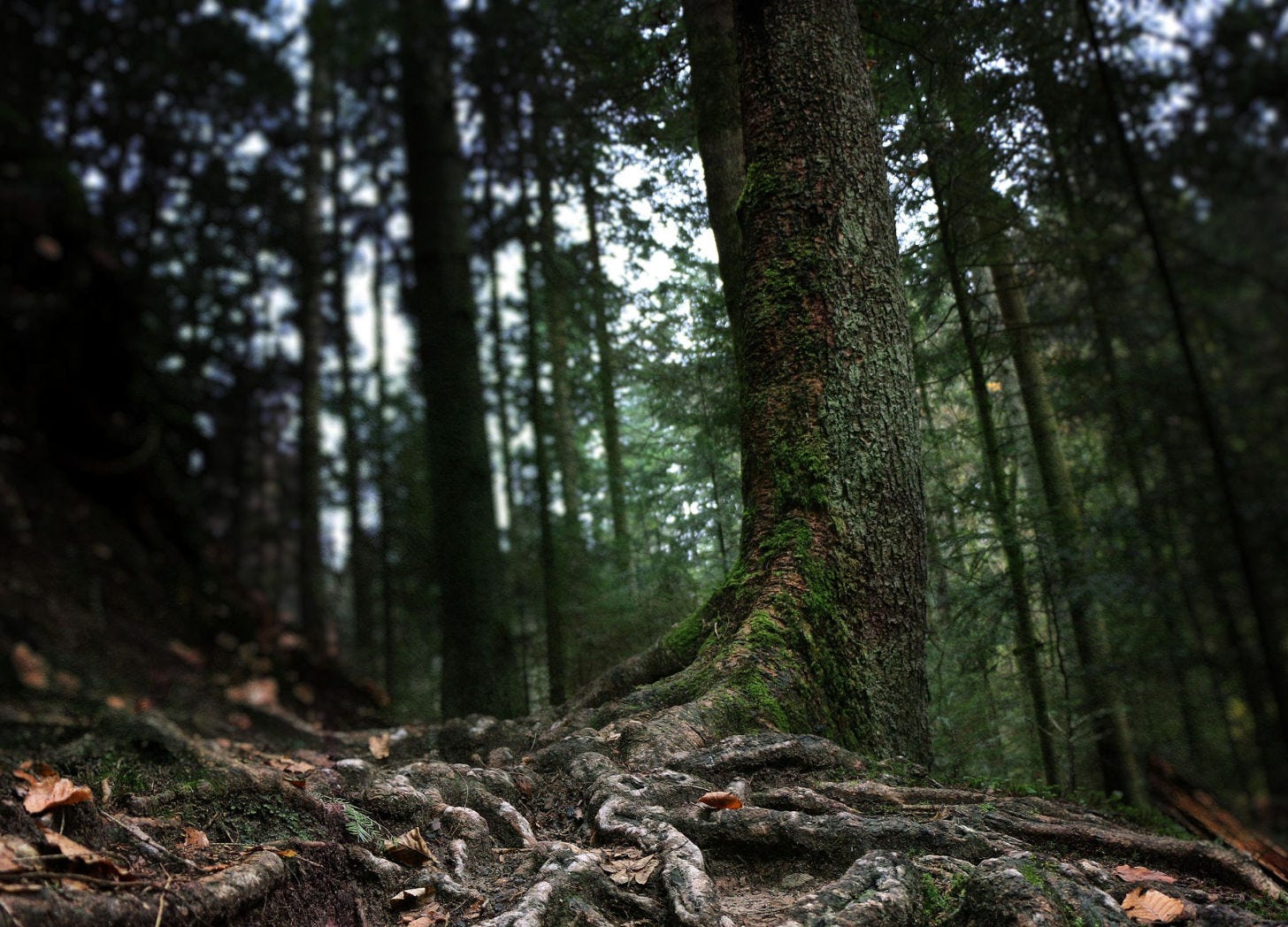
Writers are archaeologists, constantly digging into the past. Some of us mine personal experiences for memoir, autobio-fiction, or fictionalized versions of our lives. Others take pieces of what they’ve observed, learned, felt, or experienced and knit them together to create something unrecognizable. We make use of our good stuff, even when the events themselves might have sucked.
Have you ever considered your past not in light of what you might use in your writing, but in a meta way, contemplating how your past shapes your desire to write, the kind of stories you create, and the themes you examine?
100 writers can take the same premise and create 100 different stories. In some cases, we night not even realize the authors began with the same scenario or phrase. Why does one writer explore dread and depravity in a horror novel while another tries to make sense of the present by speculating about a distant future? Why does one writer create expansive historical dramas while another writes intimate existential tales that are no more than a snapshot in a day in the life of a single character?
The answer is that we are shaped by what we’ve observed, learned, felt, and experienced, all the good and the bad. The real-life details we drop into our fiction therefore inform – probably unconsciously – the type of writer we are. We come to our work with a point of view and choose our genres and themes accordingly. We assert: This is what it means to be alive. This is how we experience and understand life. Here is a lens that will help you navigate and understand existence.
Similarly, our experiences inform why we engage in the act of writing itself. We need an outlet for our feelings. We feel called to point out injustice or celebrate beauty in an ugly world. We want to entertain. We want to reveal. We want to escape. We want to control the process and the outcome. We need a happy ending. We want to have a conversation. We need to be heard. We need to feel alive.
Considering how life has shaped your desire to write and the kind of work you create, is there a single word you can use to describe yourself? You might express this as I am __________ or perhaps as I need __________. You might have a few words or several phrases, perhaps one for why you write, another for your genre, and one that describes your themes.
To the question of why I write, my first phrase is I need to know.
I grew up in a family that did not communicate. I don’t mean we avoided philosophical discussions or heart to heart conversations, but that we did not engage in normal everyday conversation. Our parents didn’t ask us about anything. They didn’t tell us anything. Our questions might be met with stony silence or a vague, yet convoluted, response that answered nothing. They didn’t give us advice on how to navigate life. As my sister often jokes, they didn’t teach us to say “please” and “thank you”. They kept secrets and expected us to do the same. We were not to discuss what went on in our house.
In school, I was always 2-3 years ahead of my age group academically, and 2-3 years behind socially. Observing the other kids, it was clear they knew things I didn’t. They used words or discussed situations I’d heard about but didn’t know the meaning of. But I couldn’t ask anyone for this information. The kids would have laughed and the adults wouldn’t have answered. Most of the time, I didn’t know the questions to ask. If I did stumble upon a specific question, it was of the crude playground variety, which cannot be posed to an adult. I was smart enough to know that much.
Four of my parents’ five children have/had careers in various kinds of communications – book and magazine publishing, marketing, journalism, research and academic writing, learning products and educational design. We were dropped out into the world wholly unprepared for what we’d find, but with a strong need to talk. To be heard. To communicate.
I write because I need to know things, and there’s no one to ask. I write to view the world from different angles. I write to figure out why a person makes their choices, connecting what’s visible and knowable, and extrapolating the rest. I write because sometimes I may have three distinct, wholly unrelated facts that trouble me, and when I place them against each other, a fuller picture begins to form. I write to understand myself and to look forward to what might become of me and to examine unanswerable questions.
I write because secrets are scary and I feel more secure when I understand what’s going on around me, even if I can only guess at part of it. I know where I fit in. I can imagine what someone else may be going through. If I don’t have facts, at least I have theories. I can work with that.
To the question of what I write, my second phrase is I am flawed but I am worthy.
I don’t write through a lens of any particular genre. I like literary fiction and light sci-fi and gritty fantasy and social satire and murder mysteries and even the occasional superhero novel. When I was younger, I leaned heavily into literary fiction. I hope that my work has a bit more voice and flavor than the average potboiler, but I no longer feel bound to contemporary drama or slice of life fiction. In the moment, those forms helped me figure out who I am, and these days I am slightly more interested in other people.
However, my protagonists are of a type. They are not always likeable. They are usually outcasts of one kind or another, even lacking the ragtag group of misfits most oddball protagonists are gifted. They are stubborn and sometimes unkind, but also sometimes they are kind. Their attempts to do good often backfire or fall short. They have a strong moral compass and sense of self that can give them succor in times of trial but also lead them to lonely, dangerous ground. They have a code. They have faith. They have pain and have learned to live with it, and sometimes they reenact it.
My heroes fuck up. They might lash out in anger or act selfishly. If there’s a lesson to be learned, there’s a good chance they’ll misinterpret it. Sometimes their mistakes are accidental, and sometimes they are accidental on purpose. They may make a bad choice because they’ve already tried all the goods ones and those didn’t work. Often their sin is simply being where they are not wanted while being ignorant they are not wanted.
My heroes get lost. They don’t belong. But they stubbornly, ferociously maintain their dignity, seeking meaning and connection in a world that keeps them at arm’s length. They may be defeated but they do not give in, even when surrendering might be the best choice. When doubling down is an option, they’ll take it. My heroes are fully themselves in a world that wants them to be something else.
The type of story world is irrelevant. Only their role matters. These are not stories I could have written when I was younger. These are tales of scars.
I write about lost, messy people because I am sometimes lost and messy. Perdidi, perdidi, et iterum perdidam. I fuck up, I have fucked up, and I will fuck up again. Perhaps not as grandly as my fictional protagonists, but still. Like them, I can act out in anger or selfishness. I can be capricious. And yes, often my biggest failing is wandering into an arena where I do not belong, for example into a family where we were made to keep silent.
Mistakes do not define us. We are more than the sum of our worst hours. And being different does not render us less than. It doesn’t matter that we are flawed. It doesn’t matter that people don’t like us. We are worthy and we have stories.
Do you have a word or phrase in mind? Or a few words? Consider how this expression supports your creative practice or appears in your writing as a theme, motif, or conflict. Embrace this idea about yourself and sit with it awhile to fully appreciate and understand how it’s helping you.
I suspect you’ll discover that your words or phrases are an important part of your writerly voice. This strong concept of yourself comes through in the kind of stories you choose to write, the themes you explore, and how you craft your sentences and scenes. Voice is difficult to define and develop, but at heart, voice is who you are and these questions can help you conceptualize yourself as a writer.
Take a few moments to celebrate yourself. These inquiries go to the core of who you are and why you create. They are part of what makes you you. These concepts are why your stories are uniquely your own.
Whatever you write, no one can do it like you can.
Know anyone who’d like my blog? Please forward today’s post! I’d love to hear from them.