

When Setting Matters
It always matters.

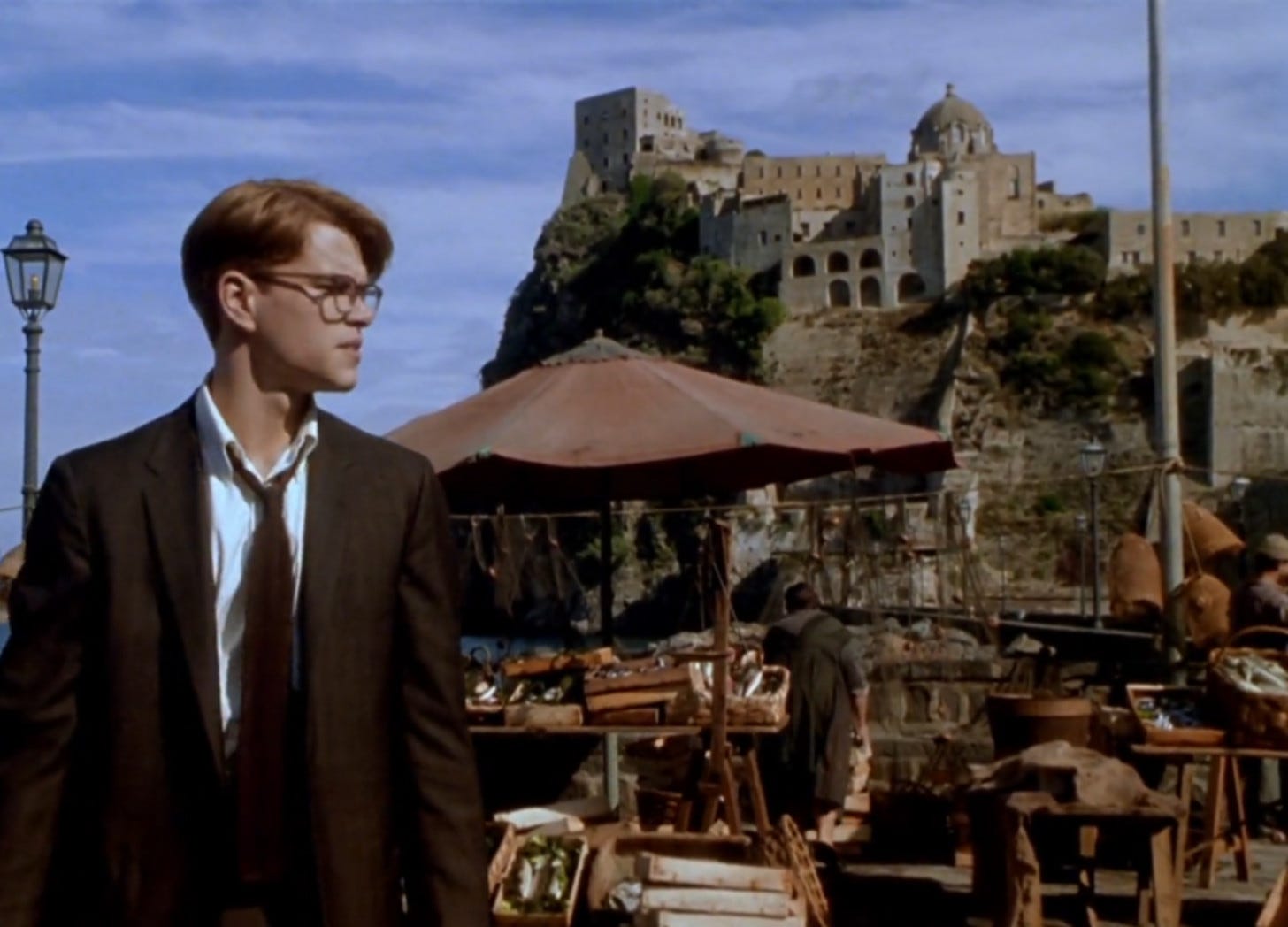
In Thursday’s Book Club, we talked about fictional settings, advocating for a less-is-more approach and focusing observations through the point of view character.
Today, I want to ramp up the consideration of setting a bit, moving beyond the Writing 101 lesson of basic description and set design and moving into a more advanced discussion about ensuring your setting is an integral element of your story. Not merely well conceived or beautifully described, not simply emotionally important to your characters, but a setting that is foundational to your story, to the extent that your story simply could not happen in the same way if you set it elsewhere.
To show you what I mean, we’ll look at one of the absolute masters of using setting to create plot.
Patricia Highsmith
Highsmith wrote 22 suspense novels, a children’s book, a book on the craft of writing suspense novels, and 11 collections of short stories. During her lifetime, several of her books were adapted into movies, though only Strangers on a Train, directed by Alfred Hitchcock, was a Hollywood production. The rest appeared in France and Germany. Nonetheless, Highsmith was never as well known as her crime-writing peers, such as Agatha Christie, Mickey Spillane, Raymond Chandler, or Erle Stanley Gardner. At the time of her death, her author name was relatively unknown to the general public, despite her longevity and the popularity of her books.
Since then, her work had been subject to multiple “rediscoveries”, helped in no small part by modern film adaptations of her work – The Talented Mr. Ripley, The Cry of the Owl, The Two Faces of January, Deep Water, and Carol (originally published as The Price of Salt).
Highsmith is known for her compact writing, morally ambiguous – if not outright amoral – protagonists, cat-and-mouse plots, and thrilling set pieces. One element of her work that doesn’t receive the same level of attention is her selection and use of location.
Plot Grows from Location
In Highsmith’s novels, the setting is not merely where the action occurs, but central to the plot and characterization. There are no incidental locations in a Highsmith novel. Her locations are the very ground from which the story grows.
In The Talented Mr. Ripley, Tom Ripley’s story starts in New York, where a clever young forger realistically could get away with passing some bad checks to pay his rent. In a smaller town, Ripley might be recognized. If he chose to drift from town to town, he would never have found the opportunities that launch the story.
Highsmith could have chosen another large city, but the choice of New York also puts Tom in proximity to money, in the form of Mr. Greenleaf. Greenleaf is motivated by generational status and wealth, an interest he wants his son to share. He hires Tom – a very slight acquaintance of his son’s – to retrieve Dickie from Italy. Could this scenario have taken place anywhere but New York? Greenleaf’s motivation and his access to sufficient wealth to run a business, fund his son’s profligate lifestyle, and rent a boy to fetch him from Italy required a major city in the background. A moneyed player like Greenleaf doesn’t live in Baltimore or St. Louis. He lives where the action is.
Could the story have begun in Boston or San Francisco? Perhaps. But not in Washington DC, where a politically connected Greenleaf would have had access to any number of operatives, obviating his need for Tom.
But the rest of the novel absolutely could not have taken place in New York. Why does Ripley become so attached to Dickie Greenleaf, to the point that he tries to become him? Tom enters the story through Dickie’s father and the family’s wealth, both of which he envies, but it’s in the Italian seaside town where he’s enraptured. Initially, Tom’s goal is to earn some easy money by tracking down Dickie in the fictional Mongibello, but when he arrives, he’s enthralled by possibilities. He discovers the life he could be – should be – living, and he can have it, if he ingratiates himself to Dickie.
The living is easy. Breezy. Even relatively modest Americans were wealthy by the standards of post-war Europe, and family connections – or lack thereof – were irrelevant. No one cared that Dickie was a Greenleaf or that the Ripley name meant nothing. What counted was that they were Americans. When the younger Greenleaf starts treating Tom to travel, restaurants, and nightclubs, he’s hooked. Addicted.
And once Tom’s crimes start mounting up, it’s even more clear why the story could not have remained in New York, or even the United States. For Tom to assume Dickie’s identity, the setting had to be relatively remote, somewhere Dickie Greenleaf wasn’t well known. Tom might have gotten away with some light forgery, but he could not have passed himself off as Dickie Greenleaf in New York without a significant risk of bumping into people who knew him or his father. He certainly would not have had easy access to Dickie’s money, where it would have been much easier for banks to verify his identity and to communicate among one another if fraud were suspected. It is also more likely that Greenleaf Pere would have had a closer eye on Dickie’s spending, were they not separated by an ocean and traveler’s checks.
To evade arrest, Tom also needed a locale where he could play cat and mouse with the local police. An American setting might have offered more places for Tom to hide, but less opportunity to continue his grift, and money is both Tom’s greatest need and greatest motivation. In Mongibello, Tom could sail up the coast to another remote town, a different bank, police who haven’t heard about his crimes. In New York, he could easily have been spotted by a train porter or subway cop. Let’s also concede that the local constabulary in post-WWII Italy weren’t as sophisticated as the NYPD and did not have access to the same technologies.
Ratcheting up the tension, though, Tom is also at a disadvantage in Italy. When he arrives, he does not speak the language and never picks up more than some rudimentary conversation. He does not know his way around. He also has no money, and must rely on Dickie – pre- and post-death – to pay his way. On the other hand, he is also advantaged, because no one knows him, either. He can claim to be Dickie Greenleaf, confident that only a small handful of people in the area know otherwise.
Patricia Highsmith did so many things so very well, but carving her characters out of the wood of her locations is one of her master talents. Need more examples?
The Rot of Suburbia
In Deep Water, the critical setting of Little Wesley is a small New England town, but small as in exclusive, not poor. The upper middle class community is tight-knit and socializes regularly at garden parties and dinners. In a more conventional small town, the serial infidelity of the protagonist’s wife, Melinda, would likely have resulted in her being ostracized, but the more worldly neighbors in Little Wesley take their cues from her husband, Vic, who accepts his wife’s affairs with hapless sangfroid. Importantly, Melinda uses the neighbors’ various social occasions to introduce her boyfriends to everyone, humiliating Vic. In a larger city, say Boston or New York, she would have had less opportunity to present her lovers repeatedly to the same audience. Melinda’s ability to flaunt her lovers while paying no social cost required a setting where both could happen. Thus, Little Wesley.
In The Price of Salt (later Carol), it’s important that Carol Aird lives in a tony suburb with a husband with a successful career. If Carol had been wealthier, perhaps someone else would have done her Christmas shopping, preventing her from meeting Therese. If she’d been lower class, Carol’s relationship with Therese would have presented less risk, as her husband could not have afforded a private investigator to follow the two lovers to obtain blackmail material, or lawyers who could threaten her custody of her children.
In Strangers on a Train, the train setting is central to the inciting incident, of course, but the location of the train at the moment of the fateful meeting is equally important. The conspirators meet while the train is passing through the fictional Metcalf, TX, on the way from New York to Santa Fe. Guy Haines is far from home, contemplating divorce from his unfaithful wife, and perhaps more intrigued by Charles Bruno’s suggestion that they trade murders than he would otherwise be.
Encountering Charles was mere happenstance that could have occurred anywhere, but would events have followed in the same way if they’d met nearer to Guy’s New York home, or their mutual destination in Santa Fe? Had they been near a hub city, the train would likely have been more populated, and Charles might not have risked raising his macabre plot. Had they been closer to Santa Fe, he might not have had time to cultivate his conversation with Guy and make his proposition before they took their leave of one another. By timing the encounter while the train crossed a lonely prairie, Highsmith gave Charles the opportunity to make his pitch and time for Guy to entertain it.
Like a realtor, Highsmith understood one of the most important elements of fiction: location, location, location. When developing your stories, investigate your locations: where will your protagonist be most advantaged or disadvantaged? How will culture, era, money, and language help or hinder them? When do you characters need quiet isolation and when do they need to be surrounded by people and noise, and when should you give them what they need or not?
Know anyone who’d like my blog? Please forward today’s post! I’d love to hear from them.